
Diplomatic Post
Glorifying War Criminals and the European Agenda
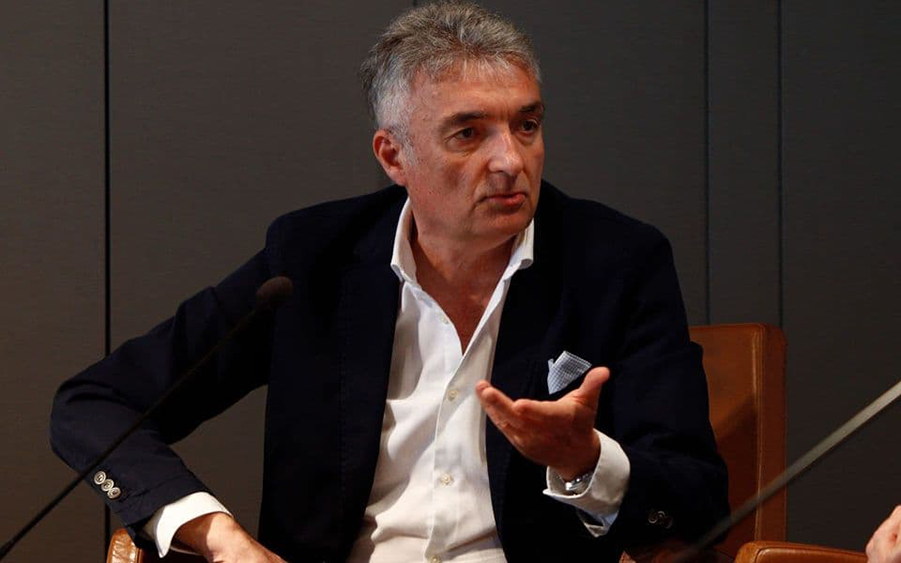
By Miodrag Vlahović
The initiative by the largest opposition party to remove the Chetnik duke from the position of Speaker of the Parliament has highlighted numerous inconsistencies and “structural flaws” in Montenegro’s European agenda.
Instead of condemning Andrija Mandić’s actions and supporting the motion for his dismissal, the nominally leading party in the ruling coalition—Spajić’s PES—is struggling to, first, avoid taking a stance on the substance of the matter (war crimes, genocide, and the politics built upon them that relativize and justify them) and, second, explain its refusal to support the dismissal.
Judging by their public statements and activities, Enlargement Commissioner Marta Kos and the Head of the EU Delegation, Austrian Ambassador Johann Sattler, find themselves in a similar state of confusion and ambiguity.
Neither of these is a new phenomenon; however, in the situation created by an outburst of overt nationalism and hatred—amidst mourning for the chief butcher of the aggression against Bosnia and Herzegovina—they are taking on a new significance: one that is worse and more destructive than anything we had previously been accustomed to seeing …
Betrayal of European Values
Spajić’s party has, therefore, found itself in a tight spot: it lacks coherent arguments to reject the DPS initiative.
Old formulations now appear even more foolish: the “thirty-year rule of the DPS”—while the party is in a coalition with the very faction of the formerly unified DPS that broke away in 1997 (SNP, DNP, Democrats); shallow, petty-bourgeois lamentations over a “dark past”—as if opposition parties were to blame for the fact that Greater-Serbian nationalists still celebrate the murderers and cutthroats of lost wars; and, finally, the silence—impossible to hide and impermissible to ignore—from all PES members of Spajić’s cabinet, a silence in which Deputy Prime Minister F. Ivanović is, by virtue of his office, the quietest of all.
Instead of any serious, responsible statement or stance reflecting the alleged European character and civic orientation of PES, we hear endless repetitions of the same old phrases about closing chapters (by the end of the year!) and Montenegro’s certain European future.
Deputy PM Ivanović, who leads the way in these performative activities, shows little interest in the ideas circulating in major European nations (not just Germany and France) or in political trends within the EU. By acting this way, he and his current party demonstrate that they care nothing for the substance and content of the European agenda, nor for the values upon which it is built. That is why PES remains—and will continue to remain—silent regarding the celebration of a war criminal, expecting that no one will ask whether the apologists and promoters of the very policies that led to crimes and genocide (which, of course, they do not acknowledge!) can actually lead us to EU membership.
Yet, that question has become unavoidable for Montenegro.
(We will not discuss the behavior and actions of the current leadership of the Bosniak Party here. In short: they now live in fear that the dismissal of Chetnik duke Mandić could lead to the fall of the Government. Their fears are not unfounded—their numerous sinecures and Ibrahimović’s nepotistic antics are at risk…)
Ambassador Sattler’s Plastic Bollards
The issue of dismissing the Chetnik duke ought to be unavoidable for both Commissioner Kos and Ambassador Sattler.
Let us consider why and how it is not.
Ms. Kos finds herself in a particularly delicate position: ever since her first visit to Montenegro, she has fully dedicated herself to promoting the legitimacy and credibility of the Parliament Speaker’s leadership. This has ranged from the “Bobotov Kuk” excursion and photo ops with a group of the most extreme Serb ethno-chauvinists (who, after all, pay fines for spreading hatred and ethnic intolerance) to—to put it mildly—the incident where she hugged and kissed the Chetnik duke, treating him as if he were a proven champion of European values and integration.
That is why the reactions of officials to the death of a war criminal presented an extraordinary opportunity for Commissioner Kos to say the right thing—addressing all the relevant capitals in the region. Instead, after some hesitation, she made the correct decision to cancel her scheduled visit to Belgrade.
(As for A. Vučić and his regime—not in the slightest—especially following his embrace of Emmanuel Macron, which came as a huge disappointment to all Euro-enthusiasts. But let it be said: this is neither the first nor the last time for France. L’hypocrisie.)
Ms. Kos has not uttered a single word about Montenegro. There is no criticism, no condemnation. In doing so, Marta Kos is not aiding the European agenda; she is undermining it. The construct of “European leadership” involving Greater-Serbian nationalists has been compromised.
By all appearances, this reflects a specific European “fixation on Serbia”—one present in the EU’s attitude toward Serbia and now consistently spilling over into its approach to Montenegro. “Serbs are welcome in the EU”—regardless of the nationalism, destructiveness, and crimes of their leaders.
One could hardly fault this benevolent stance—if only those Serbian leaders were a thing of the past, reviled and cast aside. But no—EU bureaucrats operate under the conviction that engagement is both necessary and possible precisely with such “leaders of all Serbs,” while they are alive and in power. Anyone who doubts this is deemed “anti-EU”—naturally!
That is why Commissioner Kos remains silent about Chetnik duke Mandić. And she will continue to remain silent.
Ambassador Sattler faces a similar problem.
His public appearances are becoming tragicomic. He lost the trust of the Montenegrin opposition long ago, as his bias toward the “leaders of all Serbs” was already evident during his tenure in Bosnia and Herzegovina.
The Head of the Delegation warned that public officials and high-ranking figures in Montenegro “should not” celebrate crimes and war criminals—as if they had not already done so!
Why does Ambassador Sattler have more pressing business than publicly and clearly condemning a policy that celebrates war criminals? Is that so hard to say? Which negotiation chapter is jeopardized by doing so—or which European principle, rule, or value?
And that “more pressing business” consists, for instance, of holding forth on the successes of traffic regulation on the streets of Podgorica: those hated, dysfunctional plastic bollards—which are utterly impractical…
Thus, on a symbolic level, the circle closes: Ambassador Sattler is making a mockery of us. For if this represents European seriousness, then Montenegro’s European agenda is in deep trouble.
A problem that thousands of plastic bollards won’t solve. Or perhaps they will—if a joint European effort saves the Chetnik Mandić?
Montenegro deserves better.
An American disgrace: “negotiations” with Putin
There is no other way to put it: the Trump 47 administration’s stance on the war in Ukraine is a profound disgrace for the USA—and for everything we knew and believed about American foreign policy and diplomacy.
Trump’s statements—a litany of incoherence, nonsense, falsehoods, and smears—are particularly tragicomic when it comes to the Russian aggression against Ukraine.
Trump obviously—though this has been clear from the start—dares not say a word to Putin. Nor will he.
Yet he dares to—and does—lash out at Volodymyr Zelenskyy, acting as if the Ukrainian president were the one who attacked Russia.
The latest piece of incoherence from the White House’s disgruntled occupant was his call for Zelenskyy not to bomb Russian diesel fuel supplies! “Anything else is fine, but not that,” because Russian citizens are currently suffering from fuel shortages… It is surreal.
While unsuccessfully waging a—as it turns out—pointless war against Iran—a conflict that exposed the profound and dangerous ignorance of his farcical “Secretary of War”—Trump confirms that his term will be remembered as a historic nosedive and an embarrassment of epic proportions for the United States.
Standing out within this historic disgrace are his two negotiators with Putin: real estate agent Witkoff and son-in-law Kushner.
Their “interventions”, comments and proposals are exercises in sheer ignorance and shallowness; they openly and unabashedly promote the logic and expectations of the Russian aggressors, including the surrender of occupied Ukrainian territories.
When one adds to this the increasingly detailed information regarding their ties to Russian oligarchs in highly lucrative business deals, the tragic picture finds its true frame: an American pandemonium.
The country where we proudly served as Montenegro’s first ambassador—back in 2006—is no longer the same. Nor can today’s foreign policy and diplomatic representatives be compared to those of a decade ago; the decline is tragic and all-encompassing.
We hope the world will see a United States free from the primitive, nationalist, and isolationist MAGA tumor—and free from a president unworthy of the office.
That is the wish of all sincere friends of America.
PRAVILA KOMENTARISANJA
Komentari se objavljuju na portalu Skala radija. Odgovorni za sadržaj su isključivo autori napisanih komentara.
U komentarima je zabranjeno koristiti uvredljive riječi, psovke i klevete. Neće se objavit komentar koji sadrži ove elemente kao ni tekst komentara koji sadrži govor mržnje. Ukoliko se dogodi propust pa tekst bude objavljen, moderator je dužan da ga odmah ukloni čim ga primijeti ili mu neko skrene pažnju na sadržaj. Neprimjeren sadržaj će biti uklonjen a autor može biti prijavljen nadležnim organima.
Za eventualne primjedbe i sugestije mejl je [email protected].